Introduction
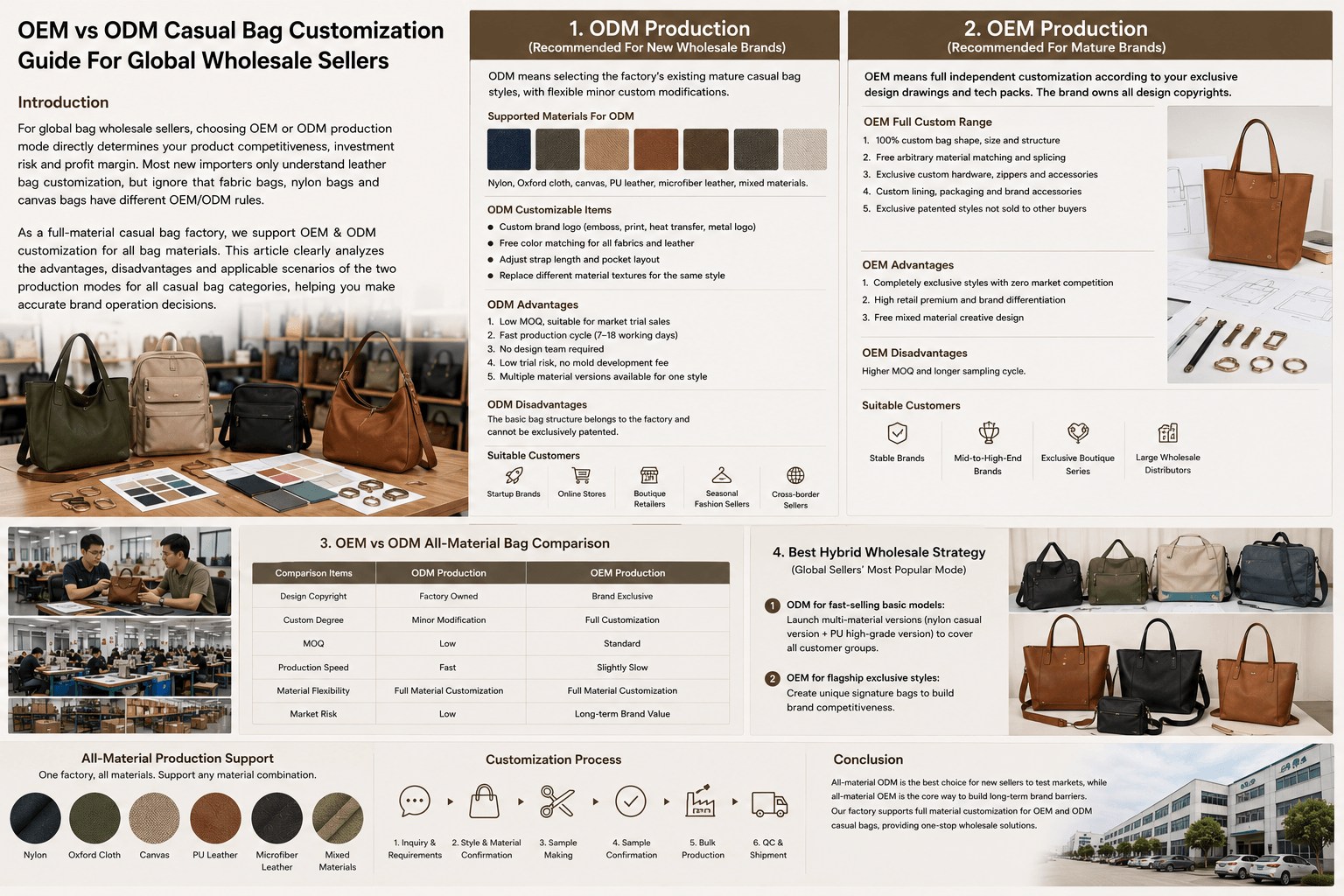
For global bag wholesale sellers, choosing OEM or ODM production mode directly determines your product competitiveness, investment risk and profit margin. Most new importers only understand leather bag customization, but ignore that fabric bags, nylon bags and canvas bags have different OEM/ODM rules.
As a full-material casual bag factory, we support OEM & ODM customization for all bag materials. This article clearly analyzes the advantages, disadvantages and applicable scenarios of the two production modes for all casual bag categories, helping you make accurate brand operation decisions.
1. ODM Production (Recommended For New Wholesale Brands)
ODM means selecting the factory’s existing mature casual bag styles, with flexible minor custom modifications.
Supported Materials For ODM
Nylon, Oxford cloth, canvas, PU leather, microfiber leather, mixed materials.
ODM Customizable Items
● Custom brand logo (emboss, print, heat transfer, metal logo)
● Free color matching for all fabrics and leather
● Adjust strap length and pocket layout
● Replace different material textures for the same style
ODM Advantages
1. Low MOQ, suitable for market trial sales
2. Fast production cycle (7–18 working days)
3. No design team required
4. Low trial risk, no mold development fee
5. Multiple material versions available for one style
ODM Disadvantages
The basic bag structure belongs to the factory and cannot be exclusively patented.
Suitable Customers
Startup brands, online stores, boutique retailers, seasonal fashion sellers, cross-border independent station sellers.
2. OEM Production (Recommended For Mature Brands)
OEM means full independent customization according to your exclusive design drawings and tech packs. The brand owns all design copyrights.
OEM Full Custom Range
1. 100% custom bag shape, size and structure
2. Free arbitrary material matching and splicing
3. Exclusive custom hardware, zippers and accessories
4. Custom lining, packaging and brand accessories
5. Exclusive patented styles not sold to other buyers OEM Advantages
1. Completely exclusive styles with zero market competition
2. High retail premium and brand differentiation
3. Free mixed material creative design
OEM Disadvantages
Higher MOQ and longer sampling cycle.
Suitable Customers
Stable mid-to-high-end brands, exclusive boutique series, large wholesale distributors.
3. OEM vs ODM All-Material Bag Comparison
1. Design Copyright: ODM Factory Owned / OEM Brand Exclusive
2. Custom Degree: ODM Minor Modification / OEM Full Customization
3. MOQ: ODM Low / OEM Standard
4. Production Speed: ODM Fast / OEM Slightly Slow
5. Material Flexibility: Both support full material customization
6. Market Risk: ODM Low / OEM Long-term Brand Value
4. Best Hybrid Wholesale Strategy (Global Sellers’ Most Popular Mode)
1. ODM for fast-selling basic models: Launch multi-material versions (nylon casual version + PU high-grade version) to cover all customer groups
2. OEM for flagship exclusive styles: Create unique signature bags to build brand competitiveness
This method perfectly balances low trial risk and high brand profit margin.
Conclusion
All-material ODM is the best choice for new sellers to test markets, while all-material OEM is the core way to build long-term brand barriers. Our factory supports full material customization for OEM and ODM casual bags, providing one-stop wholesale solutions.
OEM vs ODM Bag Production – Complete Guide For All-Material Casual Bag Brands Meta Description: Learn OEM and ODM differences for leather, PU, nylon and canvas casual bags. Choose the best production mode for your wholesale business.
2026-06-27